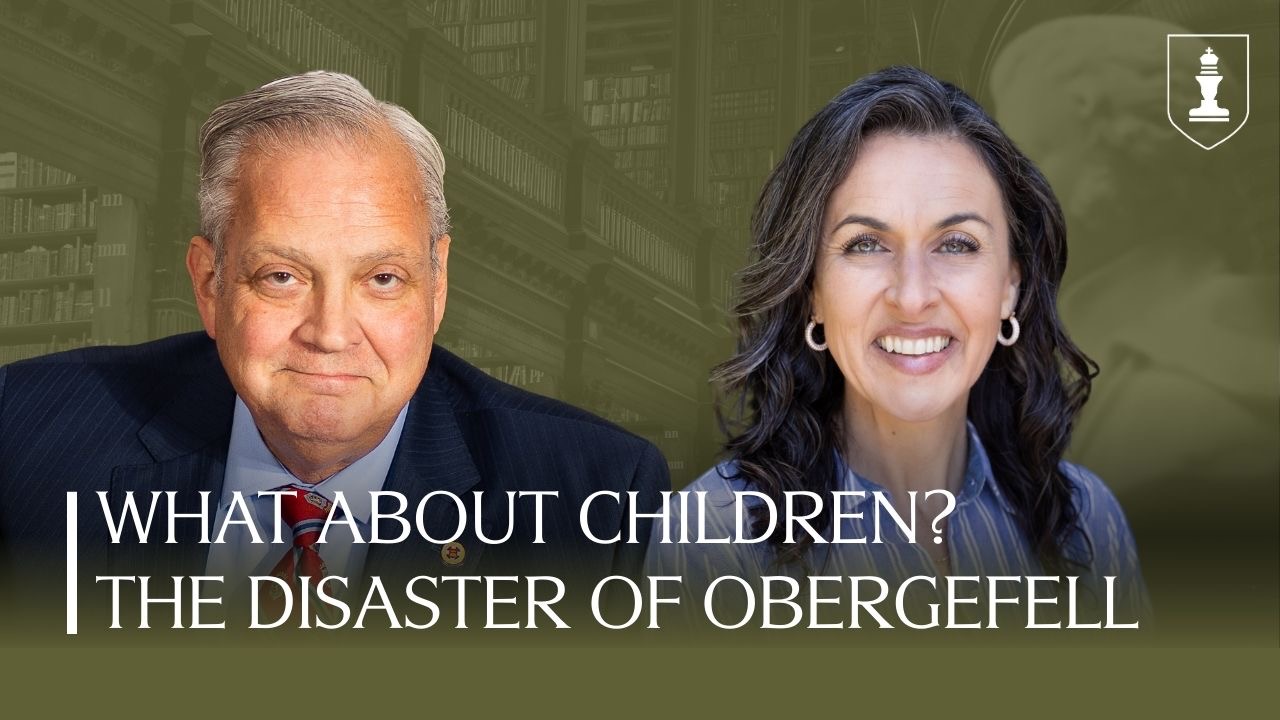
What About the Children? The Disaster of Obergefell and Its Consequences: A Conversation with Katy Faust
March 11, 2026
00:00
00:00
55:33
Albert Mohler:
This is Thinking In Public, a program dedicated to intelligent conversation about frontline theological and cultural issues with the people who are shaping them.
I’m Albert Mohler, your host and president of the Southern Baptist Theological Seminary in Louisville, Kentucky.
Katy Faust is the founder and president of the Children’s Rights Organization, Them Before Us, which is dedicated to defending children’s rights around the world. Her writing has been featured in such publications as First Things, USA Today, and the American Conservative. Her book, Then Before Us: Why We Need a Global Children’s Rights Movement, was a topic of a previous conversation. She also has spearheaded the recently announced Greater Than Campaign, a coalition dedicated to overturning Obergefell. That’s the disaster of a Supreme Court decision that coerced the legalization of same-sex marriage throughout all 50 states. And she’s seeking, along with others, to defend the rights of children in law and in society at large. That is a coalition I was delighted to join, and this campaign and the larger issues surrounding it with the moral urgency that come with this entire picture. That’s the topic of our conversation today. Katy Faust, welcome back to Thinking In Public.
Katy Faust:
It’s really good to be with you. Let me just start off by saying, I’ve been so blessed by your enthusiastic and early participation in the Greater Than Campaign. I really thought that this was going to be twisting of arms, that I was going to have to get people down, pull their teeth and say, come on, this is the time. And virtually nobody responded that way. It was such an encouragement when almost everybody that I went to said, yes, it has been too long. Let God’s people arise and build. And you are one of the first builders that got in on this project with us, so thank you.
Albert Mohler:
Well, I appreciate the opportunity to work with you in this. And I obviously believe wholeheartedly in this cause, and we’re going to get to talk about it today. And I think a lot of people will be very interested to know not only about the Greater Than Campaign and the project, but the larger urgencies behind it. That’s really the purpose of the conversation. I want to take us back to Washington DC. You and I were both there a matter of months ago for the NATCON Convention. And I have to tell you, I think your presentation was a tour de force. I thought you really had nailed the message. And you did so by a series of statements. And then at the end of every one of those statements, you said Obergefell did that. Now, we’re talking about the 2015 Supreme Court decision legalizing same-sex marriage in all 50 states. As I put it, basically redefining marriage by federal coercion in all 50 states. And I want to put a marker down for Obergefell in 2015, much like Roe v. Wade in 1973. And so I can remember how long it took for a comprehensive pro-life movement to start making any gains.
Katy Faust:
How long? Because I don’t know anything about that. How long did it take for the pro-life movement to organize and really start to see some progress?
Albert Mohler:
Yes. Well, let’s just say 1973, Roe v. Wade is handed down. So, who is organized to oppose it? Basically, some very committed nuns, Roman Catholic nuns. They’ve been heavily involved in a lot of this. And of course, you also had a lot of evangelical and Protestant women in particular who had been deeply involved in assisting women who needed help during pregnancies. But as a political movement to oppose abortion, I mean, Katy, we were deep, deep in the weeds. There was very little organization. Furthermore, just to be honest, there were far too many people who were on the wrong side. I mean, the Southern Baptist Convention passed resolutions in the early 1970s consistent with Roe. I say that to my horror, but that was simply the fact. And too many people saw abortion as a Roman Catholic issue. It took a while for the evangelical conscience to come into full play.
But beyond that, it just took a coalescence. I mean, Ronald Reagan, as Governor of California, signed the most liberal abortion law at that point in American history. He would later openly regret that act and would frankly become a staunch defender of the unborn and would actually write a book about the sanctity of human life. But the difference between, say, 1968 and 1980-it took about 12 years. It was the election of Ronald Reagan in the year 1980 that really represented the first big national pro-life victory. So I say that to encourage you. And let me tell you what I was thinking, and that is that when you were giving your speech, and I thought again, so effectively just nailing the issue by saying Obergefell did that, I wanted to come up behind people and say, just remember, Roe did that. Roe did that. Roe did that. I see the parallels. I hope that encourages you.
Katy Faust:
Well, there are a lot of parallels. I think that there’s parallels in that there’s so many parallels. Both of these were legislative, well, court decisions that they created out of whole cloth.
Albert Mohler:
Which they couldn’t get through legislative action.
Katy Faust:
Yes. Shoddy legal reasoning that brought us here. But also both of them were passed because we misidentified the victims. In both of these different conversations, we have said adults that do not get what they want are the victims. And the reality is that these bad rulings have resulted in child victimization. And so we need to understand what our role is here. Our role is to stand up and give voice for the voiceless for the children that cannot contend for their own rights. We have to represent them. We have to draw the direct connection between these terrible judicial rulings and child victimization. And that is something that our side has never been able to do. And I believe that that is why we are in the place we are in the courts and in the culture in terms of why we lost what used to be this massive consensus, both in terms of religious reasoning, natural law reasoning, tapping into our common law tradition.
There was no question about marriage and the definition of marriage until we allowed the focus to get off of children and onto the validation of adults and the affirmation of adults. And so I am so excited that we are finally doing it. Let’s be honest, everyone’s going to do it my way. And I’m very, very happy about that. I’m very happy that now that we’re going to have the conversation about gay marriage, it is not going to be about the dignity of gay adults. And it’s not primarily going to be about the religious liberty of Christians because both of those adult-centric ways of talking about marriage bypass the real victims, which are children who lose their mother or father in service of adult validation. So I’m very happy. I feel like what we’ve done here with the launch of the Greater Than Campaign, which advocates on behalf of natural marriage for the sake of child protection and makes it very clear that gay marriage resulted in child victimization.
What we did here by making marriage about child rights, not adult validation, is we said, we’re not playing your game anymore. You guys passed gay marriage because you created a ball field. And then you said, all of us have to go play on your field and your rules. Use your words and your arguments. And what we did with Greater Than is we said, we’re going to stop playing your game. We’re not even going to be playing your sport. We’re going to go over here. We’re going to have a brand new sport. We’re going to be on a totally different field. Don’t bring your tactics over here. You’re like corner kicks in your throw-ins. You bring them over to our sport. They don’t even exist. They don’t have any power. We’re not playing that sport. Your complaints about how this is about your dignity or it erases your existence or tell me about your long backstory. It does not work when the conversation is about, do children have a right to their own mother and father, or is a state-assigned stranger just as good as it relates to their development, their identity, and their protection? We’ve changed the game. We’re having a different conversation. And if we can play on this field, we’re going to win.
Albert Mohler:
I appreciate your energy. You said a lot there, but I think we need to back it off just a little bit and set the stage for really why we are about this shift. And so I have to say, personally, I’m not abandoning the field at all in that first game, but I think it is really important that we do have this new field where we have now the opportunity to point to the children and make very clear what this means in terms of depriving children of the natural right to a mother and a father, for one thing, just to start out there. So I’m going to keep working on both of these fields, but in the second field we’re talking about, we are shifting to talk about children. And I’m going to suggest that historically, that was going to be very difficult to pull off in 2016.
And Obergefell came in 2015. I said it took a while for the moral weight and meaning of Roe to settle in, even among conservative Christians. I think the same thing is true for Obergefell because when we’re talking about children, children were not really a part of the picture in the Obergefell argument in 2015. I think they were largely invisible. And of course, for necessary reasons, you have to ignore children in order to even, in an imaginary leap, get to a same-sex marriage and Obergefell. But now, more than 10 years later, we already have pathologies of such children and the reality of what this means.
Katy Faust:
It’s interesting because they did both. They said marriage has nothing to do with children. Lots of heterosexual couples, they don’t have children and they’re married. But then you could hear them, the oral arguments say, but also the children of same sex couples need marriage, so it’s totally about children. So then they passed gay marriage on the backs of this reasoning that this had to do with adult dignity and all of that. And they said, this doesn’t have to do with kids. And then they turned around and said, oh, by the way, give us children. Two years after Obergefell, the Supreme Court in Arkansas allowed two women to put their names on a birth certificate in the name of marriage equality. That decision was called Pavan versus Arkansas. And so it’s both. When they don’t want it to have anything to do with children, it doesn’t.
But as soon as they want children, they get them on the grounds that gay marriage affords them the constellation of benefits that requires that there is no distinction between same sex and opposite sex couples. It was the same thing in all of the cultural conversations leading up to marriage. This has nothing to do with children. We just want to visit one another in the hospital. We just want insurance benefits. But also, there was a glut of very poorly done social science that showed that children with two mothers or two fathers fared no different, and therefore gay marriage was okay. And so they played both sides of that.
Albert Mohler:
They did, but they really underplayed the children’s side, I want to argue. And I’ve gone back to look at the media coverage back in 2015. It’s all a bunch of same-sex couples kissing and embracing. I mean, those are all the pictures. You do get some family stuff, but I think the press and the cultural elites wanted to stay away from the family issue at that point because they knew the picture wasn’t right. And when Anthony Kennedy wrote the majority opinion in the Obergefell decision, we got pretty much what we expected at that point because we’re very aware of how his mode of constitutional interpretation was basically grounded in his own understanding of what’s morally right, the constitution he would just bend to whatever he wanted. But what he was up against was the fact that marriage had always been defined as a conjugal union.
And I think there are some people who don’t even know that language, but conjugal union means a sexual union. It means it’s pointing to the act of marriage. It’s also pointing to the conjugal act as a reproductive act. And so to get to Obergefell to this supposed constitutional right of same-sex couples to marry, you basically had to deny millennia of Christian experience. You had to deny the natural law. You had to deny all custom and tradition. You had to deny all civilizational wisdom in order to say, marriage can now be something other than a conjugal union. Now it can be merely a sexual union.
Katy Faust:
Well, and they had to ignore not decades, but centuries of common law. So marriage functions as the center of the solar system as it relates to parenthood law. Marriage and parenthood go together. And it’s not just in the United States, it’s everywhere across the world. There have been 38 countries that have legalized gay marriage. In all 38 of those countries, zero of them have reinforced children’s rights to be known and loved by their mother and father.
Albert Mohler:
You can’t use the language anymore.
Katy Faust:
You degrade it, you have to weaken it. You have to eliminate it. In the same day that Canada legalized gay marriage, they immediately demoted all parental relationships to simply legal parentage. No longer was biology something that was relevant as it related to recognizing who is and is not a parent. You can either have gay marriage, or you can believe that children have a right to their mother and father, but you can’t have both. You have to choose. You get one or the other. And that is because marriage does serve as the center of the solar system when you swap out a procreative, conjugal sun as it relates to that relationship. And you swap in a mass of gravity that centers on adult validation. All of the other planets in the solar system will realign. And that is the real basis of the Greater Than Campaign.
It is the way that children have been victimized in the redefinition of family law that takes them from a place where there is a pre-political understanding that they belong to the two people who made them. And now we’re in a place where legally they are regarded as functional accessories to be acquired by any and every adult. That is the impact of gay marriage. That is the ruling. That is the necessary outcome of Obergefell. When you make husbands and wives optional in marriage, mothers and fathers become optional in parenthood, and that is by design.
Albert Mohler:
Right. And it has been recognized in virtually every surviving civilization throughout human history. But I want to go back to something here, and that is that in a fallen world, in a fractured world, there will be, even if there were no same-sex marriage, there would be some children who lacked either a father or a mother. But civilizational wisdom, and as you say, the common law, the natural law, recognizes that those such things happen, you don’t normalize not having a mother or normalize not having a father, nor do you redefine marriage or redefine the family without reference to mother or father. Here’s a deep civilizational wisdom that’s deeply grounded in Scripture, and that is that a son may lose his father, but he never ceases to be his father’s son. And so you have a proper reference to the father or the proper reference to the mother if she should die, but you don’t say, okay, so now we’re going to, because these things happen in a fallen world where accidents and sickness and other things happen, we’re not going to say that now we’re going to redefine marriage. Instead, we speak honestly. The fact that we have to talk about the fact that there was a father and there was a mother, otherwise there would not be a child. And the child is the product, in that sense, the gift in the context of that relationship. Our civilization doesn’t even want to talk that way anymore.
Katy Faust:
So what happens when we don’t want to acknowledge that? And you are right, we have had all manner of child loss, mother and father lost throughout history. We used to see it on a mass scale post-war, generations of children would lose their fathers.
Albert Mohler:
Absolutely. Or mothers lost in childbirth.
Katy Faust:
That’s right. Before modern medicine, women were lost in childbirth. We all knew exactly what that was. Heartache and lifelong tragedy. We all understood what we mourned. As a mom who has kids that have moved through elementary school, middle school, and high school, I watch the shows that they watch. I read the books that they read. The amount of orphans that are featured as the center of the story, it’s so disproportionate to the number of actual orphans that are in our society, but the orphan functions as the center of the narrative so often because all of us understand how sad and deprived and vulnerable they are.
Albert Mohler:
The vulnerability is absolutely key because immediately when you say orphan, vulnerability is one of the main moral drivers.
Katy Faust:
That’s right. But in the world of Obergefell, there’s nothing to mourn there. Mother and father loss is not a tragedy. It is a marker of progress. We don’t even have a category for orphan. If we adopt the modern family idea of what it means to be a parent or a child, there is no loss, there’s no tragedy, there’s no sadness. There’s only celebration, forced celebration. You lost your mother or father. Congratulations. You are now one of the trophies of the new civil rights movement. It absolutely is, I think, one of the cruelest forms of gaslighting that we have ever inflicted on children to take something that is one of their most enduring wounds that goes right down to the heart of what it means to be human and say, this is the required sacrifice for this new adult equality.
Albert Mohler:
Yes. Okay. So we need to perhaps think about this for a moment, talk another dimension of this through. And so I imagine some people listening are going to say, well, if a child deserves in the right sense of mother and a father, then what about not same sex marriage, but single people adopting children?
Katy Faust:
So I used to work at the largest Chinese adoption agency in the world. I was the assistant director. I’m also an adoptive mother. And I can tell you, adoption is redemptive. Adoption is what a good adoptive friend of mine says is divine plan B. It very often is the way that God redeems a broken situation, but adoption is not for adults, is not for same-sex couples. Adoption is for children. They are the client. Meeting their need is the goal of a true adoption process. What do children need? Whenever possible. Well, all children need their mother and father, but as somebody who has parented a child who began their life with significant deprivation, I will tell you, maybe our adopted son needed a mother and father more than our other children did because he was emerging from some devastating deficits, and it took both the absolute maternal softness and gentleness that I brought and the very hard reinforced boundaries that my husband brought to pull him out of what was, 10 years. I mean, it took 10 years for him to stabilize after we had him. This is not about adults. This is not a way for adults to get kids. Adoption is for children. And if that means that some adults are excluded, which it should. That’s the purpose of adoption screening. It is there to exclude adults who are not in the child’s best interest. The goal is to place every child with a loving family, a mother and father whenever possible.
Albert Mohler:
Right. And in a broken world, sometimes we’re patching things up as best we can. And because of the importance of the child and the centrality of the child as our moral concern, sometimes we have to just do the very best possible for that child under the circumstance. But you offer a revolution on what you’re saying there, Katy, and I’m going to ask you to do it again. And that is that you say it’s that even adoption. So I think it’s a good parallel issue and the moral, I think, the biblical and theological issue is the same. It’s not about parents. It is about children.
Katy Faust:
Yes. Welcome to my world, Dr. Mohler. If you bring up the subject, I’ll make it about kids. But adoption, there’s no accident there. I mean, it directly goes together. Adoption is a just society’s response to children who have lost their parents. And actually, we spend a lot of time talking about adoption in the Greater Than Campaign because a lot of people think, well, kids with two mothers or two fathers, they’ve lost their parents just like kids who have been adopted. So what’s the difference? The difference is adoptive parents are working to mend the wounds that children have experienced. But the new ways that parenthood laws are regarding children are as items to be awarded to any and every adult. It is a place where we inflict the wound on children in the name of adult equality rather than seeking to mend the wound so that we can really institute child justice.
We talk in the Greater Than Campaign about one of the main ways that we have seen family law changed since Obergefell is the law has required, the law has been obligated to do something that biology prohibits, and that is making two adults of the same sex parents of a child. Now, how do you do that? Because biology is a massive bigot when it comes to parenthood. And so they have had to figure out some other way-
Albert Mohler:
It still is, by the way. You used the present tense because it still is. Still takes a sperm and an egg every single time.
Katy Faust:
Every time. Yes. It’s so funny because I had quite a few Twitter throw downs after the launch of our campaign and people…And I’m like a little mouse on Twitter, so obviously I’m super hesitant, but there were people that are saying, well, gay couples, they can still have kids if they want. And we’re like, explain how do they have kids? How do gay couples have kids? Oh, well, it could be a previous heterosexual relationship, or they could go to the sperm bank or they could adopt it. What do all of those things have in common? Tell me about those pathways. What do they include? Ah, yes. They all require the child to lose their mother or father or both to be in that. You do not have kids. You have to acquire children. Do you understand the distinctions there?
There is one family structure that does not require a child to lose their mother or father to be in it. And that is the definition of marriage that should be enshrined in our laws, not because of some religious zealotry, but because it aligns with the child’s natural design, their need for their own mother and father that grants them the biological identity that helps them answer the question, who I am, who am I, that maximizes their development because there’s a maternal and paternal investment that statistically puts them in the home of the people who are most likely to ensure they are safe and loved. These are child-centric realities that do not change regardless of what five Supreme Court justices say or how we tinker with children in a laboratory or how often we repeat love makes a family. There are hard and fast realities of children that we will either recognize and then abide by so that children are protected, or we will ignore and children will be victimized. And in the Obergefell decision, children were ignored.
Albert Mohler:
Okay. So let’s talk about that for a moment. That wasn’t the first time children were ignored. And so we have a transformation in American law because children were certainly not ignored throughout most of the history of the common law and throughout even most of the constitutional history of the United States. Something happened, and I think it happened just after the Second World War in particular when this individualism and the idea of individual rights, and individual rights applied to sex, and individual rights applied to sex apart from marriage. And even in the birth control, contraception decisions at the Supreme Court, the first one was the right of married couples to use contraception. And then, that clearly wasn’t the point. And so before even the decade was out, you end up with now, okay, well, now it’s for any adult to have access to contraception, obviously within a heterosexual relationship, otherwise you don’t need a contraceptive. But the point is that all of a sudden, now the individual adults right to something related to sex, that’s what sets the stage here, both for Roe and for Obergefell.
Katy Faust:
Yep. The how did we get here question that is so often asked is I say there was three revolutions. There was a cultural revolution, there was a technological revolution, and there was a legal revolution. And you’re exactly right: children are the forgotten victims of all three revolutions. The cultural revolution was that sexual autonomy, the liberation from these patriarchal expectations that sex belonged in marriage. Well, guess what? Children are the victims of that.
Albert Mohler:
Also, historic Christian expectations and historic Jewish expectations that were the framework of Western civilization.
Katy Faust:
Yes. The technological revolution that you identified where the pill separated sex from babies and then IVF that separated babies from sex. Children are the constant losers of separating sex from babies and babies from sex. And then there was the legal revolution, where we redefined the most child-friendly institution that the world has ever known and transformed it into a vehicle of adult fulfillment. The first wave of that was not gay marriage. It was no-fault divorce. No-fault divorce, which I would say probably is Ronald Reagan’s largest regret. When he passed the first no-fault divorce law in California in 1969, we removed permanence, that expectation of permanence from the marital relationship. And we said, well, if you’re no longer happy being in a marriage, it can cease to be a marriage. And then the gays are like, great. If marriage is just a vehicle of adult fulfillment, let’s remove the complementarity of marriage because that’s what it takes to make me happy.
And now we’ve got the polycules that are saying, well, if marriage is just a vehicle of adult fulfillment, if it doesn’t have anything to do with kids, which clearly it doesn’t, let’s remove the expectation of monogamy from marriage.
Albert Mohler:
Right. Throughout human history, number has been a far less significant figure than gender.
Katy Faust:
Yes, that’s right.
Albert Mohler:
So in other words, you’ve had polygamy and all kinds of things. What we haven’t had is the abdication or rejection of the conjugal union.
Katy Faust:
At Them Before Us, we spend a lot of time critiquing no-fault divorce because it deserves massive condemnation. It has wrecked a generation of children, but from a legal perspective, it did not upend the solar system of family law in the same way that Obergefell did. Obergefell put right at the center of the universe, squarely, adult validation and identity as the highest value.
Albert Mohler:
Because that is what Supreme Court Justice Anthony Kennedy wrote as the moral impulse of his majority opinion.
Katy Faust:
Right.
Albert Mohler:
It was a sense of self in the universe.
Katy Faust:
When adult sexual autonomy is god, children are the required sacrifice. Those two things are hand in hand. They go together. You see that in every sense, right? So at the Greater Than Campaign, we’re just saying no. No. Your adult equality should not override the fundamental rights of children. Their rights to their own mother and father are greater than whatever validation or agenda or autonomy that you feel like you deserve and that you need some kind of state sanctioned court validated affirmation. No, children’s rights to their own mother and father are greater than your supposed equality. And that is the basis on which this incredible coalition that you’re a part of has risen up.
Albert Mohler:
So how did you come down this road? So before, Greater Than, before, even Them Before Us, how did you come to be so involved in these issues?
Katy Faust:
Just got angry, just got really angry.
Albert Mohler:
Angry as a…? Angry as a mom?
Katy Faust:
Honestly, as a woman who had worked with children for a couple decades, my husband and I had done youth ministry since before we were married. When I first started writing anonymously about this in 2012, it had been 20 years. We had done junior high ministry and high school ministry and college ministry. I had already worked at the adoption agency. I was a mom by biology and adoption. I had lots of kids in my home. I just stopped running the youth ministry at church two years ago. I mean, I’d been super involved in kids, kids, all manner of kids. And I had never met a kid who lost their mother or father, who at minimum was not curious, but very often it left this lifelong wound, this thing where maybe they were able to walk, but they were walking with a limp. And oftentimes that loss turned itself around and resulted in self-loathing and self-blame.
And anyway, so what I heard from the gay marriage campaigners was, kids don’t care if they have two moms or two dads. And I’m like, hold on there. That means a child has lost their mother or father, and that is something that hampers children for life. So I just started writing about it anonymously because these people are vicious and I know what they will do to you. And then I was outed a couple years later when this massive gay blogger doxed members of my church and forced me to go public. And then it was in 2018, I started Them Before Us because I realized we needed more than just Katy opining and keyboard warrioring. Children needed formal representation in legislative matters, in the courts, in the culture. We needed to create a bank of child stories of children who had lost their mother or father to divorce because they had LGBT parents through reproductive technologies.
We needed to do what the other side had done so effectively, which has changed the culture by creating a backstory of the victims. But their victims were always adults who didn’t get what they want. I wanted to share the stories of the real victims: the children who were objectively harmed because adult desires were elevated above their fundamental rights to be known and loved by their mother and father. So I cut my teeth on the marriage issue. I ended up becoming an expert on reproductive technologies like surrogacy and IVF and sperm and egg donation because in the technological realm, children are being victimized on a mass scale through big fertility. And now we’ve circled back to marriage again, marriage, this fundamental child-centric institution that it creates the boundaries for child thriving. And without those critical walls, that little city, that microcivilization, that mini society that inhabits our children and they’re ravaged when those walls break down. So that’s what we’re doing at Greater Than is we are going to, with God’s help, rebuild the walls of that city.
Albert Mohler:
There’s so many interconnected issues here. And so for instance, you mentioned reproductive technologies and you mentioned IVF. And I just finished a massive writing project on this myself. And the fact is you can’t do any of these issues justice because they’re all so massive, but they’re also interconnected. And so I’m going to go out on a limb here, not with you, but I think with some people trying to think this through with us, we’ve turned children into commodities and reproductive commodities, IVF commodities. And by that, I do not want anyone to hear me say that parents, a mom and a dad, a married couple who have a children through IVF. I’m not at all saying they do not love their child as the child, period. I am saying it’s a part of an industrial complex that is increasingly aggressive, and quite frankly, is fueling the revolution to subvert marriage itself and to subvert the family and to turn children into consumer goods.
You have this thing, a firm like Orchid with embryo screening and all the rest. I mean, so all the time they’re saying, no, we’re not reducing children to a consumer good. They want to say, have a better child. Have a better genetic child. And the other thing I want to offer here to have you pick up on is it’s not fair, but we see the strategy whereby the mainstream media and the cultural elites are going to hold up a picture of domestic tranquility with two men who are legally, according to the law, married to each other. We don’t believe they’re actually married in a covenant, but nonetheless, they have a marriage license and then two women and then their children. But what they don’t admit is that this is an interruption in the entire human story. In other words, I regret to say, I don’t think we’re going to have a full knowledge of how devastating all of this is for generations.
Katy Faust:
Yes.
Albert Mohler:
Does that make sense?
Katy Faust:
Yes, absolutely. I was posting a lot about divorce over the last couple of days on X, and the stories of children who are like my parents divorced when I was four, and I am still feeling the effects now, even though I’m a six-year-old woman. And my parents divorced after I went to college. And I’m still totally destabilized by it because now I’m caring for my own children, but I’m also caring for two sets of parents that both have medical issues, and they’re not caring for each other. I mean, we didn’t have tons and tons of children of divorce in the 80s and the 90s at the peak of the divorce epidemic, speaking about this. It took decades.
Albert Mohler:
Absolutely. That’s exactly the right point.
Katy Faust:
That’s right. So it is always hard. When we are the Vanguard, when there’s a brand new epoch of family redefinition, we are going to be somewhat up against the wall when it comes to the actual testimonies of children. And this is even harder. This is an even harder case to make because there’s much fewer children with two mothers or two fathers than there were children of divorce. And the political pressure for them to shut up is so much stronger. I was on a call…thembeforeus.com has probably the largest bank of stories of children who have two mothers or two fathers or an LGBT parent of any place you’re going to find on the web. Most of them will not share their stories under their own name because they are desperately trying to keep their two mothers happy or they know that if they step out of line, they could lose that relationship.
They’re seeing their mothers cut off other family members just for voting differently, let alone having a bigot in their own home who believes that children should have their mother and father. I mean, the political pressure on these kids is so strong. It is going to take a long time before this small group feels like we can even have a couple who will speak publicly about it. So we are at a bit of a disadvantage because the cost is extremely high. For the few kids who are old enough to talk about the pain of mother or father loss, even if they had two loving mothers, it’s steep. They very often need to make peace with not having a relationship with their parents at all, and then being turned on by their community for being an enemy. So it’s going to be tough, but the natural law and the reality and the self-evident truth that children come from a man and woman, the sociology that we have that says those two adults are the place where children are most likely to be connected to, invested in and protective of them.
We have all the truth on our side. We need courage. We need to be clear. We need to properly identify the victims, and then we need to humanize their stories. And so we do have a couple testimonies of children with two mothers who are going to be featured on the Greater Than Campaign website so that you can listen yourself for how even though they had loving parents, they hungered for their missing father. They struggled with identity issues. They could not even put two words the kind of deprivation they experienced until they were older. They knew that they were hanging out or overstaying their welcome at their friend’s house who had dads, but they didn’t know why. Oftentimes, until they’re out of the home, married on their own or have their own children, they suddenly get hit with this blast of, wait a second, this is what it’s like to have a relationship with my own child. This is what it means to have a man and a woman in the home. Oh my gosh, this is what I lost. You’re right. It may take decades, but we’re not going to wait decades to start fighting.
Albert Mohler:
There are a couple of other dimensions of this I really want to raise with you. One of them is that there is a disingenuousness on the part of many in the elite culture and in media and all the rest. They don’t acknowledge that when you are looking primarily at same-sex married couples, in a legal sense, and you’re looking at their acquisition of children, you’re talking about a very privileged socioeconomic category overwhelmingly. And so one of the most interesting things is that I hear people say, well, yes, but look at these pictures. And the pictures are of, except for the gender of the parents and the absence of either a mother or a father, depending upon the set, the presentation here is of a middle-class American comfortable life. And I look at that, and I understand, okay, this is a destabilization that is incredibly powerful. It takes talking out loud to overcome this destabilization. Does that make sense?
When you look at this, it’s presented as a great cultural achievement that we’ve reached this moment, and there’s just no acknowledgement of the underlying reality and of the long-term results of all of this. By the way, if those children are going to have children, then they’re going to either have to be in a conjugal union, or they’re going to have to continue the child industrial complex. No one’s really talking about that, honestly. It’s all photographs and USA Today-type feature stories.
Katy Faust:
Well, the socioeconomic aspect is important. There are only two good studies. If anybody has tried to have a conversation about this online where you’re like, kids need mothers and fathers and kids with two moms, they’re going to struggle within seconds. They’re going to have that link from Cornell that says 75 out of 79 studies show that kids with two mothers or two fathers fare no different or even better than kids raised by heterosexual couples. So I did a deconstruction of that on our Substack just a couple of months ago. And when you actually look at the methodologies of those studies-
Albert Mohler:
And how do they define the issues?
Katy Faust:
Oh, it’s like what qualifies as the same sex household, but it’s the methodologies they use. They’re not pulling government data. They’re recruiting people from LGBTQ centers. They’re not looking at whether or not these children were on welfare or abused or have IEPs. They’re just asking the two mothers or two fathers, “Hey, how’s your kid doing? Oh, they like having gay parents? Great. Looks like there’s no difference.” But there are two studies that were done that did show no difference with kids who are raised by lesbian mothers specifically. One of them came out of the Netherlands in 2000, I think, and it showed academically that children with two lesbian mothers did not fare any different, but it was probably because the lesbians are rich.
Albert Mohler:
That’s the socioeconomic dimension I’m talking about.
Katy Faust:
That’s right.
Albert Mohler:
If you look at the same-sex couples with their children versus heterosexual couple, married couples with their children, the heterosexual couples cover in a vast economic array of situations, whereas it’s not really true of the same sex couples.
Katy Faust:
It’s expensive to make a motherless baby, especially. You got to have a lot of money. If you’re going to separate genetic mother and birth mother and social mother. It’s so foreign to our species. It takes an awful lot of technological gymnastics and about six figures. If you’re going to create a child separated from their mother. It’s a little less expensive to do it with fathers, but still you’re going to put yourself in a different socioeconomic category. And obviously, that might be some of the places where we’re seeing those genuine no differences emerge. But interestingly, I know kids who are extremely bright, did very well in school, had two mothers, but you can’t really grade the father hunger. It’s just this gnawing ache inside a child. Some things are hard to measure and the hunger and the longing that children have to be known and loved by the two people responsible for their existence, it’s hard to put on a chart.
Albert Mohler:
Yes. By the way, one of the cultural strategies that the other side has used in this for a long time is the photograph and the profile story and et cetera. And it is really interesting. I haven’t done this in the last few months, but just about once a year, I will take a look at family stories as presented. I’ll use USA Today as an example because I think its cultural messaging is just transparent. So you can always figure out what USA Today is doing. No subtlety there. And if they’re going to do a story on the family, they can’t just talk about mom and dad families. They’ve got to bring all this in. And the way they bring it in is it looks like a third of children are being raised by same sex couples. And of course, that’s not at all true, but it’s a dominant cultural script and boy, are they sticking to it. You are trying to assault that dominant script.
Katy Faust:
Yes. I often will say, hey, when was the last time you heard a national politician say children need mothers and fathers? No, they talk about two-parent homes, or they’ll say kids need loving parents, or they need guardians, because that is actually one of the major effects that gay marriage had. Obviously we saw a transformation in law. They stripped the words mothers and fathers from a variety of different parenthood statutes because here’s the crux of the Greater Than Campaign. What Obergefell required was a flattening of all distinctions of the natural family. Now you can’t say mother or father. That’s discriminatory. Even just saying mother and father, it feels like it’s too exclusive. So they neutralized parenthood statutes and they just said parent one, parent two, they talked about guardians, they talked about loving parents.
What else? Biology. Biology was too discriminatory. So instead of biology and adoption, they created a new pathway of parenthood called intent-based parenthood or de facto parenthood, where an unrelated adult could acquire a child that’s unrelated, no background screening if they had a valid contract. They bypassed that conjugal union, that procreative aspect. Now there’s nothing special about that at all. It’s just one of many different arrangements.
What about infertility? It used to be this medical condition where heterosexual couples could not achieve a pregnancy or life birth after 12 months of unprotected sex. Well, that also is discriminatory because even after 12 months of unprotected sex, same-sex couples will never both be able to achieve a pregnancy or a life birth.
Albert Mohler:
You’re kidding me.
Katy Faust:
I know I’m scandalizing you, but it’s true. They can’t.
Albert Mohler:
No. I mean, honestly, I’m a little embarrassed at the moment. I’m thinking in two millennia of Christian conversation, no one ever had to say these things before. It’s just ridiculous. And frankly, the assault at the very base of creation order here is so shocking. We just need sometimes to hear ourselves say out loud how shocking this is.
Katy Faust:
It is shocking. It’s anti-child because now the only thing in the Obergefell universe, the only thing that makes a family is, did the adult get what they want? We have erased all of the distinctions of the natural family, but those distinctions matter to children. Mother and father matter to children. A biological connection for the sake of their identity and their protection matter to children. The procreative relationship, where the child does not lose either parent to be in the home, matters to children. But what Obergefell required is the elimination of all those distinctions in law. And now we really have legally reduced children to the status of accessory. And so in that speech that you mentioned at the top of our interview at NATCON, I just gave a variety of different situations. The Chinese couple that has 21 children, three of which are under the age of…I’m sorry, 15 of which are under the age of three.
Albert Mohler:
And they’re not even sure if that’s a couple.
Katy Faust:
Oh, who even knows? Actually, the New Yorker just came out with a huge expose on all of that a couple days ago. Those 21 children, five have been born, since the rest have been taken into custody. But they could legally acquire all of those children because California instituted the Uniform Parentage Act where nobody looks, nobody cares. Nobody asks when people acquire children through reproductive technologies. And they don’t ask because it’s discriminatory to even question, are these the genetic parents of the child? It doesn’t matter. Don’t look because otherwise adults aren’t equal.
Albert Mohler:
But that is the most important moral argument. But I’m going to put a marker down and say it’s also a financial issue. You’re looking at a vast reproductive technological industry. When Russia invaded Ukraine, one of the most interesting aspects of all this was how many surrogate mothers for same-sex male couples in the United States were trapped by the Russian invasion. We only know most Americans were surprised by that, but they eventually just put it out of mind. But in the case of that New Yorker article and other things very similar, the New York Times, the Washington Post, the LA Times, they’ve all done some pretty significant reporting on this. By the way, we’re not talking about American citizens in many of these cases. We’re talking about very rich people from other parts of the country coming in to spend untold amounts of money to buy children.
Katy Faust:
Yep. We have foreigners. We’ve got Chinese billionaires that have hundreds of children through Californian surrogates. We’ve got elderly men who are raising twins that they acquired through IVF and surrogacy, who then were subsequently removed because he was keeping them in cage-like conditions. I mean, he’s a 72-year-old guy with twins, six-year-olds, surrogacy acquired. But gay marriage did that. Gay marriage redefined parenthood laws so that men could in essence raise their own caregivers and nobody would bat an eye. That’s a family in the world of Obergefell. The two Chinese couples, one of which has CCP ties. We have no idea what was happening with these kids. They obviously didn’t care for them and loved them as if they had been their own children. It kind of appeared like they were offering these children up for some kind of services to people that would arrive every now and then at the front of their Californian mansion.
Well, we’ve got Brandon Keith Mitchell, who is a convicted sex offender who acquired his children, his child, through surrogacy, and nobody even knew that he had already been convicted of sex crimes against a 16-year-old. Gay marriage did that too. Do you understand that gay marriage simply means that any adult, single, married, gay, straight, fertile, infertile, can acquire the child, as many as they want in whatever way they want, foreign national or not, convicted pedophile or not, and to put any kind of stopgap in that anything is considered discriminatory.
Albert Mohler:
Absolutely.
Katy Faust:
That is the place that gay marriage has brought us.
Albert Mohler:
Okay. I know if I got you started, you would pick it up and go with it. I appreciate that. And I appreciate your intensity on this. And that leads me to my final question here, which is, so what do you really expect out of the Greater Than Campaign? What do you really expect? Just talking honestly, what kind of timetable are you looking at? What kind of results do you want out of this? What’s the goal?
Katy Faust:
We’re going to win.
Albert Mohler:
Okay. Define winning.
Katy Faust:
Yes. Three things. We are going to play a whole new game. We are going to ask questions in policy and in the courts. That is very, very different from the questions they asked before. It is no longer going to be, what is your backstory? How do you feel? How do you identify? Do you have dignity? We’re not going to be talking about the adults or to the adults. We’re going to be talking about the children. The question is, do children have a right to their own mother and father? Do those two adults benefit them in ways that state-assigned strangers do not? Is there something special about the parent-child relationship that earned the privilege of being considered a natural right, something that is untouchable, not something that is given by the state, but something that is protected by the state. We’re going to ask those questions instead.
We’re not going to have the court ask, should we overturn gay marriage? We are simply going to say, should a child’s own mother and father be elevated in policy? And do they benefit the child in ways that an adult who acquires them by a contract does not? We’re going to be asking a different question. Like I said, we’re not going to even be playing the same game they were playing, playing a whole other sport. We’re asking different questions. We’ve defined the terms differently. This is not about adult validation; this is about child protection. So we are going to advance that kind of reasoning in policy matters. And then when it arises to the Supreme Court or appellate court, we’re going to be having them ask a different question, a question that aligns with natural law, social science, and common law. And we’re going to have the stories of children that are going to be able to be there to say, I was harmed because my mother or father was excluded from my life. So that’s number one.
Number two, we’re going to change public opinion. I think we’ve learned from the pro-life movement that it’s not enough for a terrible decision to fall in terms of the courtrooms. We have to help people understand that this is about justice.
Albert Mohler:
It’s necessary. But not sufficient.
Katy Faust:
It’s necessary. We need both. We need to change laws, but we also need to change hearts. And so we have, thank God, a cadre of incredible conservative influencers and leaders who are on board with this. You saw some of them in the video that released with the Greater Than Campaign: Josh Hammer and Michael Knowles and Allie Stuckey and Lila Rose. There are several others who are all on board with helping the public understand the direct connection between gay marriage and child victimization and natural marriage and child protection, and helping them see that the victims of marriage are not adults who don’t get what they want. It’s children whose needs are deprived of them when we get marriage wrong.
And the third is we want to turn the church into a child-centric fighting force. We want the church to understand that both biblically and historically, they have confronted a variety of different cultural threats to children, whether it’s foot binding in China or female genital mutilation throughout the Islamic world or the abuse of children as it relates to the industrial revolution being put in factories for 14 hours a day because they were street kids and there’s no one to protect them or abortion or infanticide that has been rampant across the globe.
The threats to children change. The church’s response doesn’t. We always do two things. We elevate the needs of children, and we anger the adults who want to victimize them. And that is where we are today. We as Christians today need to step into that great cloud of witnesses, of people who understood that child protection was more important than their social acceptance. So thankfully, we have got Protestants and Catholics working on some materials that we want to deploy for the sake of the universal church so that they can understand that they actually do need to get involved in this conversation because it’s a mandate for Christians. We are here to defend the fatherless, not standby while they are manufactured.
Albert Mohler:
Katy, I appreciate so much your energy and conviction and commitment in this, your passion for this cause. I appreciate so much what you’re doing in this campaign, and I’m glad to be a part of it, and I wanted to have this conversation to help others and especially Christians to understand what’s at stake in all of this. And perhaps to shake some up just a bit to recognize what they haven’t been seeing and what we’re really called to here. So once again, tell people how they can find out more.
Katy Faust:
Go to greaterthancampaign.com and sign up. We have a little gay marriage quiz there. You can see, how much do you really know about marriage and the impact that gay marriage has had on children and their rights? We’d love to equip you. We’d love for you to stay in touch. We’re not going to spam you. We’ll send you something once a month to just tell you how the campaign is going. Get on social media, follow us. All the handles are make kids greater, and see what it is that we’re posting. Let me turn you into somebody that stands up and defends kids, like this is the time for especially Christians to arise. We are God’s plan A as it relates to protecting the most vulnerable. And this is the battle. This is the place where we need to put our feet down and say, don’t touch the kids, or you’re going to have to go through me.
Albert Mohler:
Katy Faust, thank you for joining me for Thinking In Public.
Katy Faust:
Thank you for being a part of this coalition. I’ll see you on the right side of history shortly.
Albert Mohler:
Many thanks to my guest, Katy Faust, for thinking with me today.
If you enjoyed today’s episode of Thinking In Public, you can find more than 200 of these conversations at albertmohler.com under the tab Thinking In Public. For more information on the Southern Baptist Theological Seminary, go to sbts.edu. For information on Boyce College, go to boycecollege.com.
Thank you for joining me for Thinking In Public, and until next time, keep thinking.