The 75th Anniversary of D-Day & the Extraordinary Providence of God
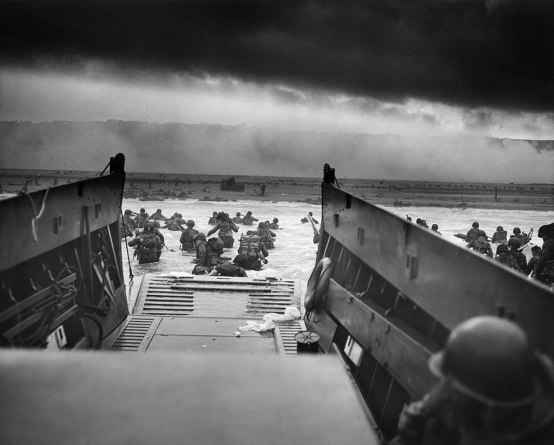
Troops from the U.S. 1st Infantry Division land on Omaha Beach, June 6, 1944. Photographed by Robert F. Sargent ( wikimedia).
It was 75 years ago. The globe was deep into World War II, the deadliest conflict in history. Germany had conquered and gained control of much of Europe. Four years earlier, the Nazis had grabbed a tight grip on France. The United States officially joined the war and linked arms with the Allies in 1941 after the Japanese attacked Pearl Harbor.
Among other things, the Allies had their eyes on Europe. Taking France from the Nazis was essential to liberating the continent. Enter Operation Overlord. General Dwight Eisenhower had been appointed Supreme Allied Commander of the Allied Expeditionary Force for the invasion of Europe. By the end of 1943, the Allies had pinpointed Normandy, the northern coast of France, as the key invasion point for May 1944.
Operation Overlord would be the largest amphibious invasion in history. Fifty miles of French coast were divided into five primary locations for the invasion: Gold, Juno, Omaha, Sword, and Utah. The Canadians and British were primarily tasked with taking Gold, Juno, and Sword Beaches. The Americans were to take Omaha and Utah. As time approached, planners strategized the landing day based upon the ocean tides. Bad weather delayed the operation to June 6th.
D-Day had arrived. It was June 6, 1944. Minesweepers cleared the ocean lanes. An aerial front dropped bombs and paratroopers early that morning. However, weather complicated and hindered the effort. In the meantime, troops made their way across the English Channel to Normandy. Omaha Beach was key to linking the other four together so as to subsequently create a highway inland for the Allies. The Nazis knew this. And they were prepared. Omaha was the most heavily defended beach; more than the Americans expected. Even so, US troops arrived at 7:00am. Higgins boats full of soldiers pulled up, dropped their bow ramps, and troops faced an unspeakable hailstorm of gun and mortar fire.
The invasion would prove a key step to liberating France and Europe from the Nazis, and thus winning the war. But it came at great cost. In total, it is estimated that 10,000 Allied lives were lost in the D-Day invasion. Omaha saw the most casualties, with about 3000 lives lost. The terror that the Americans braved that day was utterly unspeakable. Some sources say that the disturbingly gory D-Day scene from the movie Saving Private Ryan is about as accurate as could be depicted. But of course, it’s just a movie.
Harrowing accounts surfaced from the men who survived Omaha. I recently had the privilege of hearing one of those accounts of a courageous American soldier. What follows is a first-hand account of the extraordinary providence of God in impossible war circumstances.
Joe was born and raised on a ranch in western Montana. His family had homesteaded there and established a farm years prior. He grew up as a typical farm kid.
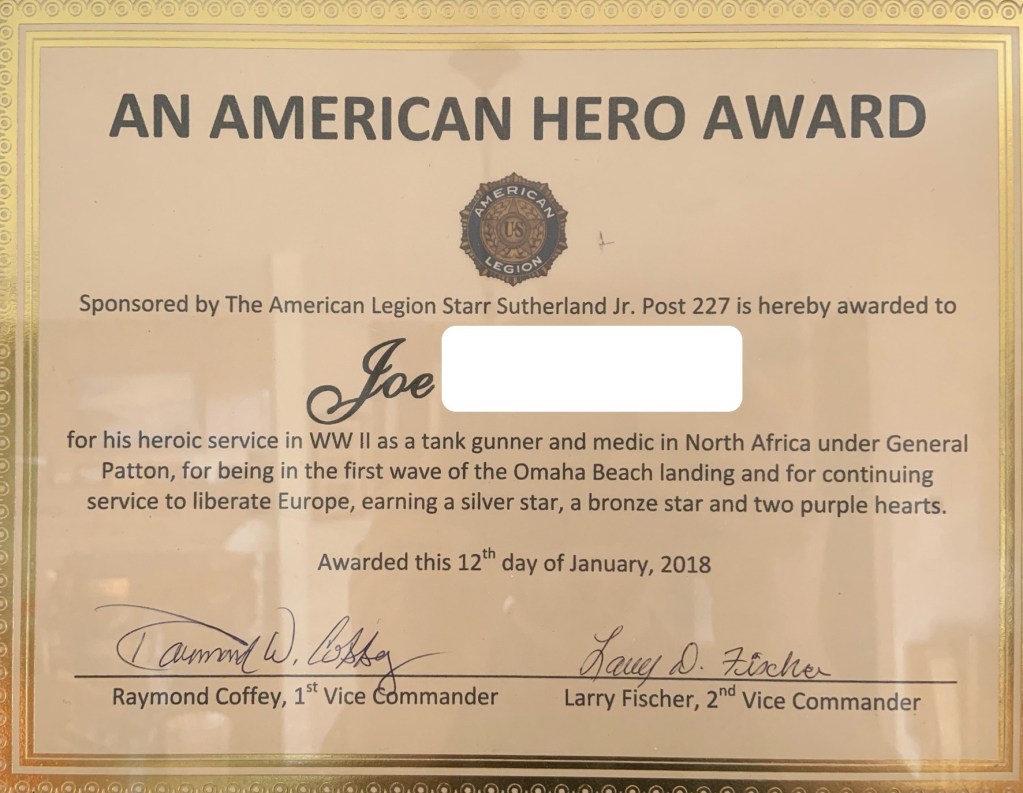
Then the war started. Joe enlisted in the Army at the age of 17. He found himself in the Second Armored tank division, under the oversight of General George Patton. Soon, Joe was in the thick of combat in northern Africa.
It would not be long until he earned his first purple heart. One day, Joe’s tank came under attack. His crew was fired upon with armor-piercing shells. One shot penetrated their tank and exploded. Since he was standing near the opening, he was launched 30 feet into the air as the tank erupted. When he hit the ground, he realized his arms and legs were on fire. After rolling around frantically in the dirt, he managed to extinguish the flames. His arms and legs still carry the scars of the attack. Joe was the only one in his tank to survive. That was his first purple heart.
With the wounds freshly bandaged,General Patton called Joe back to battle in another tank. As the war progressed,he got to know Patton. He swears to this day that Patton was the best guy heever served with. Joe recalls, “Guys were afraid of him. But you respected him.Most importantly, he was good in war.”
After serving in north Africa, the troops were split up. Some went to the invasion of Italy. Others traveled far north to England. Joe was not going to Italy. He was removed from the armored division and placed in the 30th Infantry of the Army; with the “green horns in the Old Hickory,” he puts it. At this point, he did not know about D-Day. He spent the next year training in England with the Allies. For a year, they ran drills, doing everything possible to prepare for the Normandy invasion.
Then the day arrived: D-Day, June 6, 1944. Channels through the sea mines had been cleared. The invasion was on. Since Joe had seen combat, he was given some seniority, though he was only about twenty years old. Joe’s Higgins boat was the first wave to land on Omaha Beach, the most treacherous of all. The boat ride was sobering to say the least: he recalls those dear, courageous men shaking, weeping, and turning green.
Then the moment came: the ramp fell. Joe was in the front of the boat. Men were dropping all around him as they were riddled by Nazi gunfire. Besides negotiating the hailstorm of bullets, soldiers carried up to 80 lbs of gear as they landed in the water. In some situations, sandbars prevented a closer approach. Soldiers then found themselves wading through neck-deep water up to shore. Some drowned. Those who made it to shore found themselves and their gear drenched. They still had 300 yards of sandy beach to cross under gunfire.
German soldiers fortified the beachwith mines, iron gate structures, heaven slanted stakes, and ditches. Theystationed themselves atop the large Omaha cliffs, firing down on the Americansfrom heavy bunkers.
Under those conditions, Joe spent what seemed like a lifetime traversing the beach. “Somehow, I made it from the water to the cliffs,” he says. Of the 17 in his squad, only three made it to the cliffs. Guys from other squads managed to survive by laying under dead bodies in the water. There were other complicating factors of the invasion too numerous to list. Communications were out for many. Gear was soaking wet. Some of the landings were off course. The Omaha beach cliffs were 100 feet tall with only a few ways up through narrow ravines.
The battles were far from over. Forces then moved inland. Joe was in charge of a platoon and looking after troops. Things got complicated. Supply drops went haywire. They didn’t have enough food. So, they had to rummage through deserted French farms for a bite to eat. At times, they would find smoked meat stashed up in chimneys. Then, they all got lice. It was so bad that they could hardly sleep. They had no new uniforms, so they wore the same clothes for months. When they did get new boots, Joe would soak them in water before his troops wore them. He swore that no one got blisters.
Later, General Patton would field-commission him as a captain, something very rare at Joe’s age. He and Patton then met periodically.
Then came the battle along the Siegfried Line, a 400-mile German defensive line that stretched from the Netherlands, along eastern France to Switzerland. The Allies launched a large attack from September 1944 to March 1945 along the Siegfried. Joe recalls that it was brutal. They could not get around or across the defensive barrier. They spent days at a time in fox holes under heavy shelling.
It was at Siegfried that Joe earned his second purple heart. Under heavy fire, he took some nasty shrapnel to his chest. It broke a few ribs, punctured his lung, and exited his back. What does a guy like Joe do in battle with a punctured lung and inability to breathe? Duct tape. They duct taped the hole in his chest. And it worked. Joe could breathe again (If duct tape ever had a good marketing scheme, this is it). He kept fighting that day, pulling other injured soldiers to safety. But he kept fighting. Estimates say that about 140,000 American battle and non-battle related lives were lost in the Siegfried combats.
Soon after, he was pulled from the front and sent to Paris in a body cast to recover. But Joe wouldn’t last long there. He had to get back in the battle alongside his fellow soldiers for the noble and necessary cause. So, after only a few days, Joe escapes from the aid station, finds a truck going to the front line, and jumps in. What about his body cast? He convinces a medic to cut it off so he can fight. Joe recalls that he couldn’t handle being away from his fellow-soldiers.
The year of 1944 was coming to a close. Winter was approaching. Then it happened: the Battle of the Bulge. It was the largest and deadliest battle fought by the United States in World War II and the second deadliest in American history. Though the battle lasted a little over a month, estimates say that 75,000 American lives were lost at the Bulge, about 1500 British lives, and roughly 100,000 German lives. For the Nazis, the damage was irreparable.
At one point, Joe and his crew captured a German soldier. Perhaps motivated by the earlier Malmedy massacre, some of his troops wanted to kill him right there. Joe showed mercy and let him go.
He recalls that the Bulge was utterly brutal. Supplies were low. Soldiers were freezing. Thousands upon thousands lost their lives. But again, somehow, Joe survived. Those are about all the details he gives.
Then the war ended. After extraordinarysacrifice and bloodshed, the Allies won.
Joe returned to the States. He landedin Seattle, still in uniform. Like many veterans, he had nothing. There werefew jobs when he returned. So, while still wearing his uniform, Joe got a jobdriving concrete trucks in Seattle. Throughout the remainder of his life, hedelivered and poured much of the concrete around the city, including the SpaceNeedle. Joe would marry and raise children in the Seattle area, where he stilllives today.
Among other things, Joe earned one silver star, two purple hearts, and three bronze stars. But for years, he hardly spoke of the war. He says he didn’t think much of what he did. Even so, the small pieces of shrapnel from the Siegfried Line foxhole make their way out of his body at times to this day, serving as a memorial.
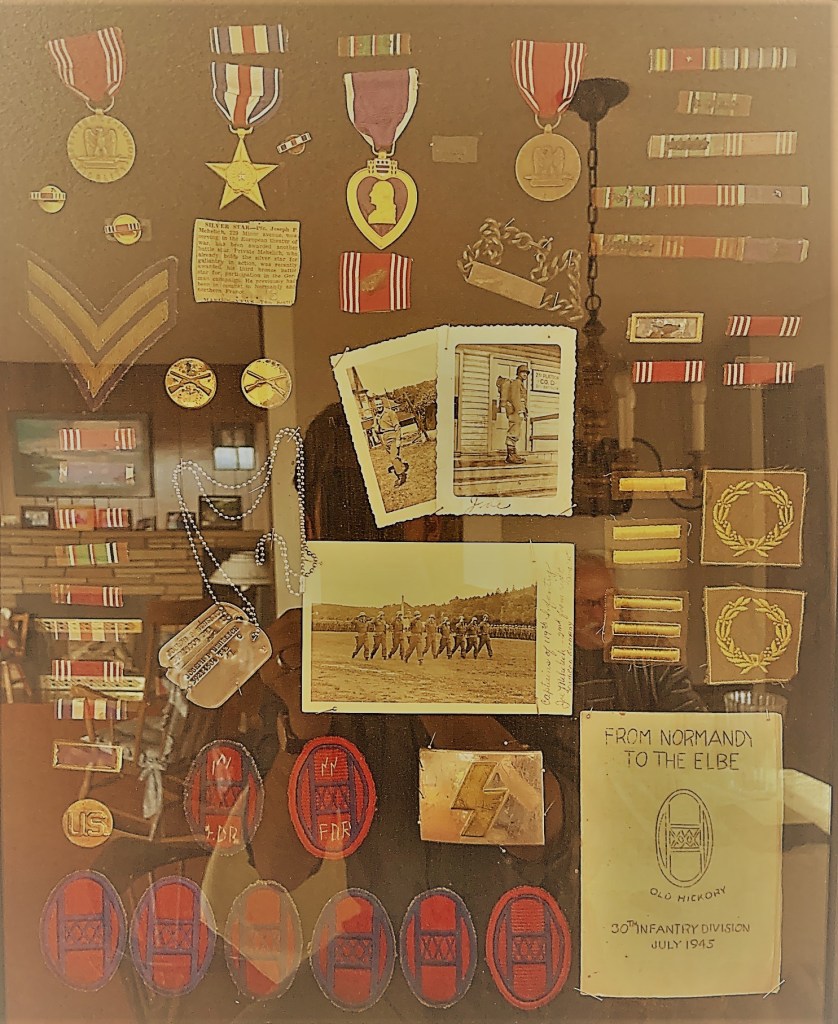
Joe’s memoirs
Then, in yet another act of God’s remarkable providence, an additional reminder of the war came. A few decades after the war, Joe was going about his day, shopping in a Seattle grocery store. Then, a man about his age approached him. In a German accent, he comes up to Joe and says, “Do you remember me?” In tears, the man fell down on his knees in the middle of the store and said, “You saved my life! You captured me in the war, but let me go! After the war, I moved here and became an American citizen.” It was the German soldier upon whom Joe had mercy.
Joe is now 95 years old. He has several dozen grandkids, many of whom love the Lord Jesus Christ. Already this year, he has read the New Testament several times. He says he especially likes the book of Revelation. There’s a lot in there Joe can relate to. But I’m sure he especially likes the end:
“And I heard a loud voice from the throne, saying, ‘Behold, the tabernacle of God is among men, and He will dwell among them, and they shall be His people, and God Himself will be among them, and He will wipe away every tear from their eyes; and there will no longer be any death; there will no longer be any mourning, or crying, or pain; the first things have passed away’” ( Rev. 21:3-4

).