Editing the 10 Commandments and the Sacredness of the Pulpit
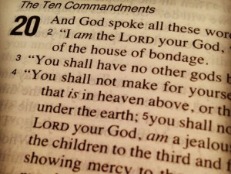
Over the past few weeks noise has arisen over the recent Christmas Eve service preached by pastor Perry Noble. Among other things, he performed a sweeping edit of the ten commandments in Exodus 20 during the sermon.
His justification for doing so was three-fold. God spoke to him, telling him to preach a message in which he edited each of the commandments, then he received affirmation from fellow-staff to do so, and a Jewish friend told him that there is no word in Hebrew for, “command.” The claim is made that instead of “Ten Commandments that you have to keep…they’re actually ten promises that you can receive when you say, ‘Yes,’ to Jesus.”
So, for example, the first commandment, which says, “You shall have no other gods before Me” ( Exod 20:3

), is better understood as, “You do not have to live in constant disappointment anymore.” Briefly, the commandments are not promises to which we say, “Yes,” but standards by which we are shown to be condemned so that we would see and sorrow over our inability to render ourselves acceptable to holy God, repent, and embrace the Person and finished work of Jesus Christ for acceptable righteousness.
So, the errors here are significant. First, this is a remarkable edit and jumbling of Scripture (which others have sufficiently addressed ). But there are some other issues which merit consideration, especially for those of us who stand behind a pulpit each week.
One issue here is the sacredness of the pulpit. By pulpit, I do not mean a physical stand which sits in a church, but the spiritual act of preaching the Bible. Biblical preaching is to be a sacred endeavor, because of the sacredness both of the office of pastor and the task of preaching. Further, the sacredness is not ourselves, but the God we represent, the God for whom we speak, and the word of God from which we preach. In that sense the pulpit carries with it a sacredness.
Consequently, here are some considerations for the sacredness of the Christian pulpit:
- The pulpit is too sacred of a place to be making edits on the word of God.

The church of the living God is “the pillar and support of the truth” ( 1 Tim 3:15

). A pillar serves one function: to continually sit there and lift up something without altering or wavering. Preaching, then, is instituted by God to do just that. The pulpit serves as that unwavering truth-pillar through submitted and surrendered expositional preaching.
When we come at Scripture with the red pencil, or in any other way, we risk functioning, not as the pillar, but the editor of the truth. At that point, we are no longer a pillar. We are more like a self-appointed sculptor.

God has summoned preachers to the pulpit for one task: not to edit his word, but exposit it; not to alter the truth, but announce it (cf. 2 Tim 4:2

).
Now, some might comment here, “OK, what’s the major deal? It’s just a few minor edits. Several other helpful things were said.” God’s desire for the pulpit is to do something more helpful than say some helpful things now and then, but that, on every occasion, we accurately exposit Scripture without revision or edit (cf. 2 Tim 2:15

).
If we are revising his word then, by default, we are opening the door to several hazards.
First, we open the door to the idea that Scripture is insufficient. If it needs such revisions, then it is lacking.
Second, we open the door to the idea that God has not completely spoken. If the Lord is telling us to edit the ten commandments, then, perhaps, he will tell us to do the same with other portions of Scripture. Perhaps more verses are needed in Exodus or elsewhere. Perhaps a 67th book is needed.
Third, and similarly, perhaps God needs us to upgrade his word. If that’s the case, hopefully we have some means by which we can determine the what and how of doing so.
Fourth, when we edit God’s word, we influence people away from Spirit-filling and Sprit-leading. The more we expose people to correctly-interpreted Scripture, the more we are used to set them up for the true power of the Holy Spirit (cf. Col 3:16

, Eph 5:18

). Thus, revising Scripture subjects people to something other than the power of his filling and leading. God’s words are spirit and life ( John 6:63

); words of eternal life ( John 6:68

). Our words are not. Especially not our words used to supplant God’s. And adjudicating this is not by numbers or decisions, but faithfulness to the word.

Fifth, we open the door to putting Scripture on the judgment seat. Editing Scripture fundamentally is an act of sitting in judgment over Scripture when the opposite should be the case.
Finally, if we use the pulpit as a time for scriptural revision, then we are lowering the authority of God and elevating our own. Sola scriptura veers more towards interdum scriptura.
If we are still wondering what the big deal is, let’s recall God’s concluding words for humanity:
“I testify to everyone who hears the words of the prophecy of this book: if anyone adds to them, God will add to him the plagues which are written in this book; and if anyone takes away from the words of the book of this prophecy, God will take away his part from the tree of life and from the holy city, which are written in this book” ( Rev 22:18-19

).
- The pulpit is too sacred of a place for personal agenda.
These kinds of approaches to exposition venture away from biblical preaching and towards personal ranting. I, personally, have ventured into this error at times. As preachers, we have to be self-controlled in this area. Our task is far too sacred.

From the methods of many contemporary pastors, one might suppose that the pulpit is about agenda-enthronement. But this is not why God qualifies men for pastoring and ordains them for preaching. If we’re not careful, the whole package; the audience (perhaps a big one), the popularity, the accolades, the spotlight; it can become about us. It’s alluring. We lasso those moments on stage for the little Mr. Rant-and-Rave inside us. He’s always looking for the opportunity. But its best for him to be mortified, not enthroned.
New Testament churches are to use their pulpits only for the enthronement of Scripture, in content and method. God has one agenda for those who stand behind a pulpit. It is not personal, but biblical. It’s not to serve up our opinions, but to submit to every word of God. Christ does not give us a pulpit and a Bible to spotlight our itching agendas, but explain and apply every verse. The use of the pulpit is singular: biblical exposition from sound exegetical labor.
The pulpit is a place to stand up and disappear. We get ourselves out of the way through holding high every verse and, like a diamond, turning it to see the glory from every angle. In Iain Murray’s excellent biography of David Martyn-Lloyd Jones, he records how, in his preaching, Lloyd-Jones had this ability to vanish in the pulpit. That’s because Lloyd-Jones was an expositor. Faithful biblical exposition, by design, renders the preacher as secondary and the glory of God, primary. We are to decrease so that God may increase.
- The pulpit is too sacred of a place for lacking proper training and affirmation of biblical qualification.
If we are committing these kinds of grievous errors with respect to Hebrew words like, “commandment,” and editing the ten commandments, (without turning from the error) then we commit pulpit malpractice. It may evidence that we are lacking proper training and pastoral affirmation.

Christ deserves we take those things seriously. Preaching is the enthronement of our Master’s word. Souls are at stake. The stakes are too high to play fast and loose like this. We have got to know what we are doing. The art and science of biblically faithful preaching is not an arbitrary one.
If a pastor finds himself in a position where he is insufficiently trained and/or affirmed for the task, that’s OK. He can inform his leadership team and seek out additional training. Plenty of resources exist to equip us for the pulpit. God will bless that necessary and humble approach.

Now, can God use us if we are lacking pastoral training and proper ordination? Of course. But our Lord’s providence should not serve as permission for indifference towards our insufficient equipping. I understand that, in some sense, we are ALL insufficient for the Lord’s work (cf. 2 Cor 2:16

). We know that. We feel that. But it is both possible and prerequisite for us to be qualified in accurately handling the word of truth ( 2 Tim 2:15

, Titus 1:9

).
- The pulpit is too sacred of a place for things like subjective visions, dreams, and “the-Lord-told-me’s.”
These kinds of justifications for sermons and preaching is simply hazardous. It demonstrates a problem of authority and sufficiency.
God has designed the pulpit as a place for his authority to be exercised through accurate, submitted exposition of his word. But the more we use the pulpit for speculations, hunches, dreams, and visions, the more we diminish God’s authority and assert our own.

Yet, preaching is fundamentally to be an act of submission. As we stick to careful, verse-by-verse exposition, we demonstrate that we are in submission to God’s word, and, therefore, to God. But when we import “the-Lord-told-me’s” and biblical revisions, we are inherently questioning the Lord’s authority and teaching our audience to do the same. Dr. Martyn Lloyd-Jones’s comment from the ‘60’s is pertinent: “They are ready to listen to a man who can speak in an authoritative manner on the basis of personal experience. Doctrine is being discounted and experiences is being exalted at its expense” (Iain Murray, David Martyn Lloyd-Jones: Volume Two, 481).
God had firm words along these lines in Jeremiah’s day as well:
“Thus says the Lord of hosts, ‘Do not listen to the words of the prophets who are prophesying to you. They are leading you into futility; they speak a vision of their own imagination, not from the mouth of the Lord…I have heard what the prophets have said who prophesy falsely in My name, saying, “I had a dream, I had a dream!” How long? Is there anything in the hearts of the prophets who prophesy falsehood, even these prophets of the deception of their own heart…The prophet who has a dream may relate his dream, but let him who has My word speak My word in truth. What does straw have in common with grain?’ declares the Lord” ( Jer 23:16

, 25-26

, 28

).
Further, this subjective approach calls into question (and teaches our audience likewise) the sufficiency of God’s word. Instead of the 66 books alone, we need our subjective premonitions plus Scripture. We, then, dangerously demonstrate that the content of our preaching can be arbitrary.
Again, we have a simple task. It’s not to exposit our subjective hunches, but God’s objective word. His words are written down, so we need no hunches.
And it does not matter how many of our associates might affirm our hunch. Four hundred of Ahab’s false prophets affirmed that a false prophecy was a word from the Lord ( 1 Kings 22:6

, 19-23

).

God is not telling any of us to do these kinds of things with his word. He has already told all of us in His word that we must not alter or add to it ( Rev 22:18-19

). The Bible is the sufficient word of God. He has spoken. We pastors need to stop using the pulpit to hypnotize and mesmerize our audience with our supposed private, privileged phone conversations with heaven. These kinds of things are unsound teachings which titans of the faith throughout church history did not affirm. Our generation needs to turn back to exegetical accuracy and historical fidelity by turning away from these things.
- The pulpit is too sacred of a place to affirm pastors by superficial criteria.
We are often superficially affirming preachers. If, for example, they make mention of Jesus and say “Jesus” a lot, they seem great. But would we take that approach, for example, with our tire shop or dentist or surgeon? “He talks a lot about heart surgery and seems to love heart surgery. Never mind if he has sufficiently passed his board exams or not, correctly understands cardiology or not, and performs heart surgery incorrectly.”

The spirit of the age is glamour and applause. It’s alluring for all of us. So, we ought to guard ourselves here. Even if our audience applauds and affirms us, it’s best for us to resist interpreting that as God’s approval.
Faithfulness and success in the Christian realm are not to be pragmatically or arbitrarily determined. And it’s especially difficult for us, contemporary American evangelicals, to bring that fact into our mental grid because its not the natural or cultural modus operandi. But let’s refresh our memories with a walk through God’s faithful and successful hall of fame. Out of the entire world, Noah had about seven who liked him. During his approximately fifty-year ministry, Jeremiah probably had no converts. John the Baptist had his head chopped off in his early thirties, yet Christ called him the greatest. At the conclusion of his ministry, all Asia ditched Paul and he was alone in a jail cell.
Scripture promotes an alternative to superficial approval. It is measured by a humble surrender to, and exegetical fidelity under, God’s word (cf. Isa 66:1-2

, 1 Tim 4:6-16

, 2 Tim 2:15

). Our affirmation is to be on those who have been properly trained and ordained by existing biblically qualified men and then remain faithful, in character and proclamation, to biblical exposition.
Every one of us who stands in a pulpit struggles with the weight of the task. Combine that with the fact that the needs around us are massive, and the implication is that we cannot play fast and loose with preaching. By God’s grace, let us all fear and tremble as we carefully and correctly approach the sacredness of the pulpit each week.