Boring Preaching
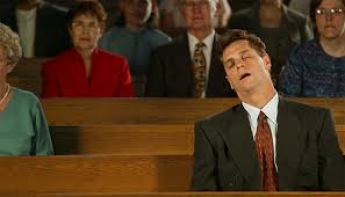
I’ve preached boring sermons. That’s why I don’t always like these kinds of quotes:
The preacher must never be dull, and he must never be boring…there is something radically wrong with dull and boring preachers.
How can a man be dull when he is handling such themes? I would say that a “dull preacher” is a contradiction in terms; if he is dull he is not a preacher. He may stand in a pulpit and talk, but he is certainly not a preacher.
Dr. Martyn Lloyd-Jones, *Preachers and Preaching*
But, Lloyd-Jones is right. I’ve had to assess what is “radically wrong” with myself at times. There is something wrong with my boring preaching.
What is wrong with boring preaching?
As the Doctor said, the Bible is not boring. So, preaching shouldn’t be either. And when we stand up to preach, we’re addressing our neighbor. We are to love our neighbor. One way to love them is to make preaching engaging. Boring preaching also communicates error about the Bible; that it is boring, irrelevant, powerless. Whatever the Bible is, it is not those things. For those reasons, preaching should not be boring.
I want to do some justice to the Bible. I want to love my neighbor. And I don’t want to communicate error about the thrill of God and his word. I want to grow in my preaching. These are some things that I hope will help me do so.
How we might avoid boring preaching:
- Preach expositionally.
Expositional preaching is engaging because you are studying a new passage each week. There is a progression in the text; a logical flow that is visible. When a pastor preaches expositionally, it draws the congregation together on a journey through the book of the Bible. This will make for more engaging preaching.
- Study hard for sermons.
The Bible is not boring. Every book is filled with engaging events, twists, irony, and gripping truths. But, these things are not always immediately visible. Often we have to work hard to find them and mine them out. It’s like a good hike in the mountains. Almost always, the most gripping vistas and stunning views are not towards the beginning, but the end. There is usually some lookout; some peak or inspiring point, but you have to work to get there. So it is in sermon preparation. Our job is to work to get to that stunning vista in the text and bring it to the congregation. Doing so will avoid boring preaching. Every text has something engaging in it. We need to find it and preach.
- Be engaged.
God made us with multiple faculties. We naturally use these when we are speaking about something exciting. If we were chased by a bear in the woods, we will re-narrate the event to loved ones with raised eyebrows, hand and arm motions, voice inflection, body movement, and such. We ought to do the same when preaching.
Far more compelling than a bear, Scripture is the living word of God. It must be preached as such. We ought to engage our whole being in preaching. If it does not come naturally, then pray that it will. Study Scripture until it grips you. If needed, practice in front of the mirror and get feedback. Do what it takes to be engaged yourself in the text. Forget about what people think in this respect. Be absorbed in the text and preach.
- Love those to whom you preach.
When a loved one is in the hospital, that grips us. We go, we visit, we weep, we hold, we speak, we pray. The way we interact with them is likely engaging. Why? Because we love them. We give ourselves to them in that moment. Similarly, imagine a dad speaking to his son as he drops him off at college in the next state. He pours out his heart. He exhorts him. He encourages and assures him. The love that the father has for his son is discernible by the son.
Love for those to whom you preach will come out. And it’s engaging. You have emotion for them. You have an urgency for them. You have a patience with them. You desperately want them to experience the change, power, and encouragement of the text. Whether it is a rebuke, comfort, or exhortation, love for the hearers will make for engaging preaching. Visitors, too, will discern this.
- Use illustrations.
Public speakers over the centuries have understood that picturesque language effortlessly grabs an audience. Even more, God has spoken to us with abundant word pictures in the 66 books of Scripture. Consider a few examples. “They will hammer their swords into plowshares and their spears into pruning hooks” ( Isa. 2:4

). “Sheol has enlarged its throat and opens its mouth without measure” ( Isa. 5:14

). “Behold, a sower went out to sow…” ( Matt. 13:3

). “When you give to the poor, do not sound a trumpet before you…” ( Matt. 6:2

). “Let not him who girds on his armor boast like him who takes it off” ( 1 Kings 20:11

). Scripture could have said, “War will end,” “Many will die,” “Not all will be saved,” “Don’t show off,” and, “Don’t brag,” respectively, but word pictures are far more picturesque and memorable in a way that grabs the reader. Word pictures and illustrations which help clarify truth effortlessly lure in the hearer like a flashing spinner on a fishing line does a hungry fish.
- Be clear
The other day, I popped on a movie that my kids mentioned. It was nothing more than characters yelling, screaming, and carrying on chaotically amidst a change of screen every second or two. I tried to follow and engage, but there was no logic to it. Clarity is a necessity to maintain curiosity. If it’s unclear what a preacher is saying or where he’s going, attention will wane. It’s how the mind works.
As someone (John MacArthur?) once said, “We must study ourselves clear.” Scripture is clear. Every text is logical, having a purpose, point, and flow. Preachers must wrestle with the text until it’s clear to them. But we mustn’t stop there. We must labor to explain, illustrate, and apply in a way that is also clear. Doing so will reduce the risk of boring preaching.
- Show clear direction
Part of what makes a great hike engaging is a clear direction. You’ve told those you are guiding where you are, where you are going, how you’re going to get there, and the sites you’ll encounter along the way. They follow and are engaged because they see where things are headed. So it is in preaching. Listeners should have some idea of where we are headed. They should be able to say, “OK, I see how we got there.” When they do, they will be more engaged.
- Say things in different ways.
Truths of the Bible are forever fixed, thankfully. God is immutable. However, under the inspiration of the Spirit, biblical writers express truths in a variety of ways. For example, the apostle Paul says, “Christ died for our sins” ( 1 Cor. 15:3

). Expressing the same truth, Peter says, “He Himself bore our sins in His body on the cross” ( 1 Pet. 2:24

). Similarly, John writes, observing the heavenly scene, “Worthy is the Lamb that was slain” ( Rev. 5:12

). Isaiah expresses it this way: “He was crushed for our iniquities; the chastening of our peace fell upon Him” ( Isa. 53:5

). Four different writers express the same truth but in different ways. We as preachers ought to work to do the same, whether we’re speaking of the atonement, the standard of God’s law, repentance, or the end times. It takes work, but it is possible. We can get ideas on how to do so simply by reading Scripture and reading how other men have expressed these truths. Doing so will avoid boring preaching.
- Listen to gifted preachers
We can be instructed in the mechanics of preaching, but there are few things that match seeing it done. That’s why we do well to listen to gifted preachers. Engaging preachers are engaging for a reason. Their sermons will feature many of the essential ingredients of appealing preaching.
- Get sermon feedback
This side of heaven, we cannot say that we have arrived in knowing all there is to know about preaching. If we’re humble enough to admit it, we always have something to learn. Those skilled in their trade usually are because they see themselves as perpetual students. But sometimes it’s hard to see how we need to grow ourselves. For that reason, we ought to recruit sermon evaluation at times. These people can serve as mirrors to help us see, for better or worse, our preaching. When an honest mirror is held up, we’ll see the blemishes more clearly, so that we can improve our preaching.
- Be fired up
I often went to the Saturday football games at the large state university I attended. Our first few years, we hardly won a game. But then things changed. We started winning. The student section was no longer half empty. As the team started scoring points and winning, fans would effortlessly jump up and down, yell, hi-five, and paint themselves up at every game. They were fired up and they unembarassingly showed it.
We get pumped up over all sorts of things. We get a raise and hi-five our spouse. Our favorite team wins and we jump up and down in front of the TV. Our kid wins his race and we test the strength of our lungs and larynx. Should it not be this way when preaching the most important truths in the universe? Some don’t think so, it seems. It appears that some believe preachers proclaiming the words of His Majesty should be partially comatose. No way. If it is normal to get fired up about some guys chasing a ball around, how much more the truths of Almighty God?
- Pray
Let’s not kid ourselves. God’s truth is so great and we are so weak, we’re going to need his power to preach something halfway helpful and engaging. That’s why we need prayer. Pray for yourself. Pray for your godliness. Pray for your study. Pray for illumination. Pray for your hearers; for salvation, sanctification, and illumination. Pray against Satan. Pray, and likely your preaching will not be boring.
I don’t want to bore my audience when I preach. That would be misrepresenting my great and glorious God. I hope to apply these principles, and more, so as to do some justice to the captivating content of his word.