5 Truths to remember while the police station burns
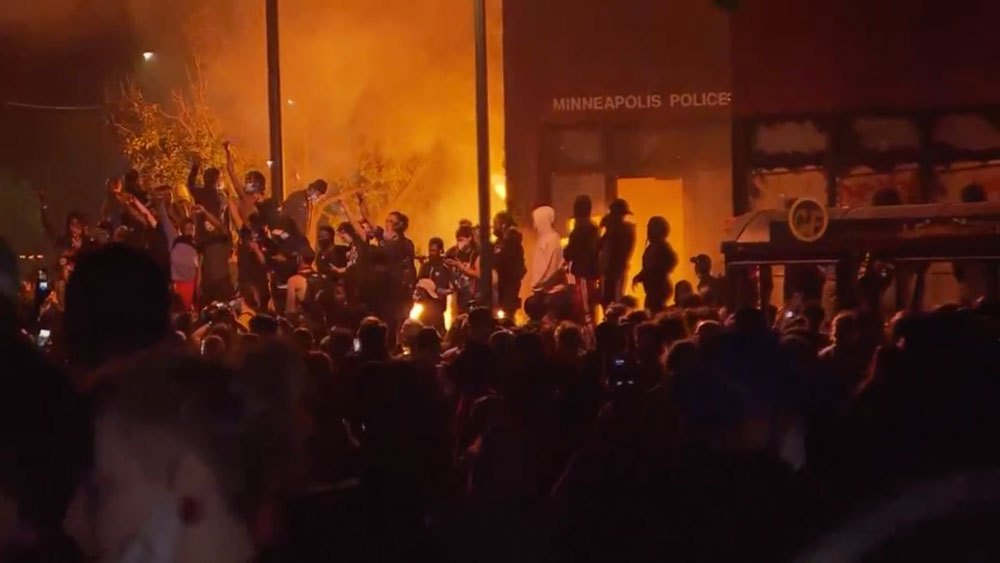
As I’m writing this tonight, on my second screen I am watching live video of a Minneapolis police building burning to the ground, overrun by protesters, looters, and rioters. It is a stunning scene for an American City to have a police building overrun and ransacked, as the fire and police both withdraw.
This riot is the aftermath of the death of George Floyd, who was killed by a group of police officers. Floyd was being arrested for forgery, and a police officer laid him on the ground, and put his knee on his neck for nine minutes until Floyd died. In response, looters emptied a nearby Target and protesters burned an apartment complex for low-income residents to the ground. Later a Wendy’s, AutoZone, and a group of smaller stores were likewise torched, as the police tried to defend their own building. Eventually they abandoned even that.
What do Christians have to say about riots that spill from racial tension? Here are a five principles to frame your thoughts:
The United States in many ways is still marred by its original sin of racism. Racial disparity was literally written into our constitution, and it is difficult to excise from a culture that grew up around it. I’m often surprised at how many Christians seem hesitant to acknowledge the effects of racism in our country, but they are there. Christians, if they are to have any kind of prophetic voice at all, need to be clear in recognizing the reality of racial injustice in our country. And by “racial injustice” I’m referring to having a police officer crush your neck for forgery.
Not only am I surprised by Christians who seem to avoid recognizing the reality of racial injustice, but at the other end of the spectrum I’m also perplexed by calls for pastors and churches to “do something” about racial issues. Racism in our country is not really “fixable” in a generation, much less in a tweet or on-line virtue signaling. Sharing a post from a celebrity condemning racism doesn’t help, and it easily comes across (at least to me) as condescending.
The real work against racism happens long-term, in the family, in the church, and in evangelism. If a person wants to make an actual difference in the world, then they ought to train anyone whom they disciple to oppose racism. Teach them the truth of the image of God in man, the reality of racism in the world, and the blessing that comes from correcting wrong. Train your kids to speak out against injustice, even if the one doing it is wearing a badge.
This is the kind of training that takes a generation to bear fruit. Of course there are things that can be done to promote morality on a societal level. Government can pass just laws, and police departments can get better at hiring. People can educate policy makers on economic and health issues that fester in our country. But all of those efforts, as good as they might be, pale in comparison to doing the hard work of raising a family that loves justice and mercy.
That’s not to say that family is the only arena where this kind of lifelong heart change can be done. Evangelism is another effective means at reaching someone outside of the gospel, who doesn’t know about the imago dei, and when they are reconciled to God through faith you see their heart change in a way that will make a difference in the world.
God gives law enforcement for the common good. This principle is taught repeatedly in Scripture ( Genesis 9:6

; Romans 13:1-4

; 1 Peter 2:14

). After the family, law enforcement is perhaps the most significant building block of society. Just laws enforced equitably lead to stability and prosperity. When those elements are missing, society collapses in on itself. The most jarring scene from the riots tonight was the police retreating from their precinct. When that happens, it means protection is gone—as evidenced by all of the destruction and arson.
Because God designed law enforcement for the common good, unjust actions by law enforcement are particularly egregious. They provoke anger from society in an unparalleled way. Minnesota averages a murder every three days. Georgia averages two a day. Why, when a law enforcement officer is the suspect instead of the investigator, does a murder provoke riots?
While I doubt those doing the looting would articulate it, their actions reveal the recognition that law enforcement is meant for good in a particular way, and that good is violated when the power is abused.
Rioting is obviously sinful as well. Those that storm buildings to take what is not theirs are participating in immoral actions—actions which the Bible calls “strife” and are not compatible with the light that Christians are called to walk in ( Romans 13:12-13

). If law enforcement officers abusing their power are an assault on common grace from the inside, riots are an assault on common grace from the outside.
There is no justification of the actions of those looting. One sin does not excuse another, and capitulating on this point reveals an absolute loss of moral compass. An iconic scene from the riots tonight was a reporter saying “its important for me to frame this story the right way…these protests are mostly peaceful.” Behind the reporter were burning buildings, fleeing police, and people looting a Planet Fitness. His statement was categorically absurd, but also very similar to Christians excusing looters.
The only hope for humanity is through the gospel. While many are dismissive of such “only the gospel” talk, the fact remains that depravity is so deep and racism so historic that the only hope for the sin sick soul is to place saving faith in Jesus Christ. The way to oppose racism and the way to oppose riots are the same—to believe the gospel, share the gospel, and call on others to come to faith in Christ.
People are scared. Many African Americans are scared for their kids, scared for their next traffic stop. Parents of police officers are scared for their kids going to work. Wives and moms are scared as their husbands and children head out. Their fear is real, and obviously justified.
Remember that it is a fear that Jesus understands because he was tempted in all ways like we are, and yet was without sin. He knew what it was like to expose injustice in the world, and what it was like to be a victim of it. But ultimately he came not put an end to riots or immoral law enforcement. Rather, he came to bring a greater peace—a peace that comes from having your sins forgiven, and a peace that conquers our fear of death.
In other words, he came to give us the gospel of Jesus Christ, to bring hope to the world.